
“Why doesn’t my child make the “s” sound correctly? Every time he says his name, “Sam”, he says “Tam” instead. Should I correct him?”
Parents have asked me some form of this question throughout the years. Children generally develop the speech sounds of their native language in a predictable order by certain ages. I often use the image below to help explain when we expect children to be able to produce a specific sound.
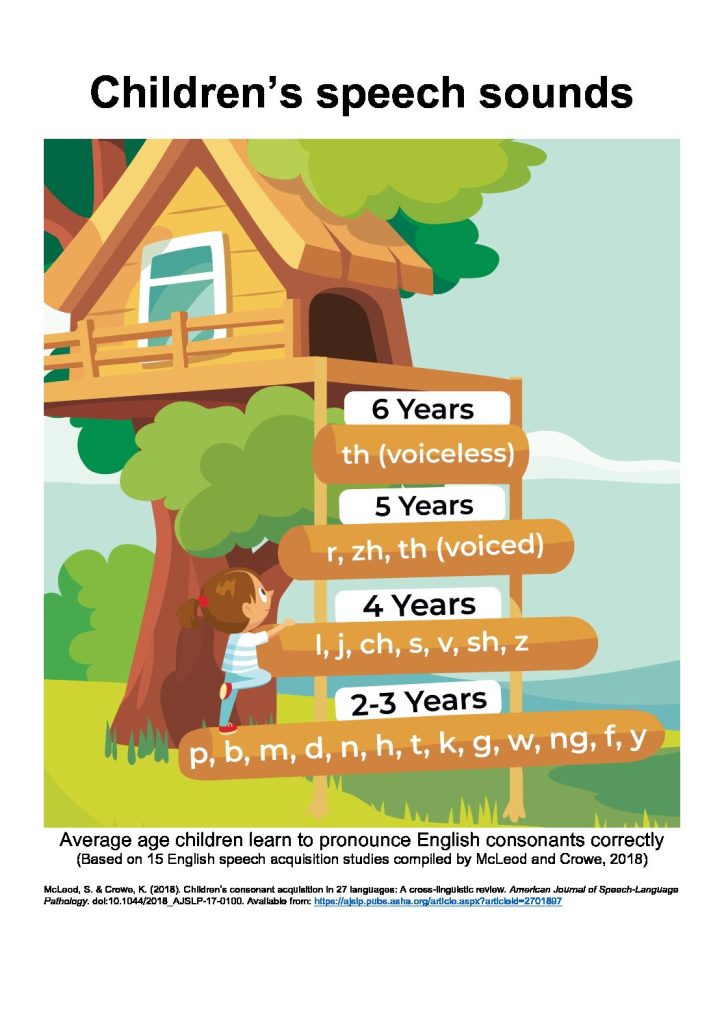
A cross-linguistic review by McLeod and Crowe updated normative data of the average age children learn to pronounce English consonants correctly within words. The researchers gathered results from previous studies and averaged the data (McLeod and Crowe, 2018).
Based on this information, 90% of 2-3 year olds are able to produce the bottom rung of sounds (p, b, m, d, n, h, t, k, g, w, ng, f, y) in the initial, medial and final position of words. The same holds true for subsequent rungs, with 4 year olds producing l, j, ch, s, v, sh, z in all positions of words correctly and five year olds producing all of the previous sounds as well as r, voiced “th”, and zh as in the middle sound in “measure”. By 6 years old, 90% of children can produce all sounds of English language, including the voiceless “th” (e.g. final sound of “tooth”) correctly within words.
If your child seems to be missing sounds expected for their age, consult a speech language pathologist. We love to help with articulation skills.
 Prietto Speech Therapy
Leave a comment